By Katie Claypool
Third Grade Elementary School Teacher
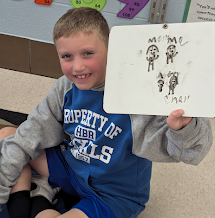
Jack envisions his family.

Nora practices breathing.

Noam reads for pleasure.
I vividly recall practicing a deep breathing exercise while assisting in one of the Early Childhood classrooms at Hinckley-Big Rock Elementary School. This experience has left a lasting impression on me. At the time, Ms. Liz, the EC classroom teacher, was trying to instill a sense of calm in her young learners as she prepared them to settle down and listen to a story. She instructed her young learners to take a seat on the rug and “Smell the cake (take a deep breath in), blow out the candles (slowly breathe out). She gently repeated this phrase, encouraging her students to close their eyes and fully visualize breathing in the scent of a delicious cake while working hard to blow out those candles. The classroom was filled with a sense of peace as everyone inhaled and exhaled. The reason this experience has resonated with me is that I remember how well it had worked and it was so easy to implement! A simple breathing exercise helped her young learners refocus their energy and shift their brains into learning mode. These important breathing exercises can increase oxygen to the brain, and stimulate the brain’s regions that control attention, emotion, and body awareness.
Now, thirteen years later, I am using the same mindfulness technique with third graders in my own classroom. See Nora above practicing smelling the cake, blowing out the candles. Mindfulness exercises extend beyond just breathing techniques at HBRES. As we deepen our understanding of the human brain and the various tools available to help our students shift into a learning mindset, we become better equipped to support them effectively and maximize their learning.
This summer, I read two books by the author Dr. Daniel G. Amen that have greatly impacted me not only as an educator but also as a parent: Change Your Brain, Change Your Life, and Raising Mentally Strong Kids. Through Amen’s work as a clinical physicist and brain disorder specialist, he describes the importance of optimizing brain health and various strategies that could be implemented to improve brain health through the books mentioned above.
Dr. Amen explains that our brain is the most amazing organ in the universe. It is the organ responsible for learning, strategizing, loving, creating, and behaving. Our brains are involved in everything we do and everything we are, including how we think, how we feel, how we act, and how well we get along with other people. Our brain is the organ behind our intelligence, character, personality, and every single decision ever made. This is just the surface of why we should intentionally care for our brains. It’s the organ we use most yet rarely think about.
Dr. Amen simply explains that when our brains work right, we work right. But when our brains are in trouble, we are more likely to encounter trouble in our lives. When our brains are healthy, we feel happier because we are likely to make better decisions and, therefore, be more successful in everything we do. There are many ways we can boost our brain’s function, such as implementing breathing techniques, learning new things, eating great nutrition, drinking lots of water, getting quality sleep, exercising, meditating, loving relationships, and consuming certain nutrients like vitamins B6, B12, and D, and omega-3 fatty acids. Notice the picture of Jack above modeling a brain-healthy strategy of visualizing. Before we began our reading lesson, I instructed the students to quickly draw a picture of something that makes them feel good. Jack immediately drew his family. When I asked how that picture made him feel, he replied, “Happy and loved.” Students who feel emotions like happiness and love are much more likely to be engaged and ready to tackle learning. Noam is practicing a brain-healthy strategy too—learning new things through reading a good-fit book. Reading can improve concentration and memory as well as reduce stress and anxiety. Through books, Noam can explore endless worlds, immersed in a great story while nurturing his mind.
What I enjoyed learning the most from reading Dr. Amen’s books is that we are not stuck with the brains we have; we can make them better at any age and at any time in our lives! This fills me with excitement and hope. Learning about brain health should start at an early age, like for the students in Ms. Liz’s EC classroom. Her students were as young as 3 years old, yet they were already on a powerful and positive path toward improving their brain health which will impact them for the rest of their lives just as it has for mine. Similar to Dr. Amen, I strongly believe that the quality of our lives depends on the quality of our choices. Simple daily habits like focused breathing exercises can add up to make a big difference in our well-being.
Here at HBR, we are committed to supporting our students in developing stronger and healthier brains, as this directly translates to stronger and healthier lives. I am passionate about educating students on brain care as early as possible, as the sooner they learn these skills, the more likely they will feel happier and live more productive lives. It is important to know that the human brain does not fully mature until around 25 years of age. During this critical development period, adults should provide children with the necessary tools and techniques to foster healthy brain habits, such as mindful breathing techniques and much more.
Thursday, October 10th, is recognized as World Mental Health Day. I strongly encourage the HBR community to take a moment to implement a brain-healthy strategy that would best benefit your needs and someone you care for. A sincere, heartfelt, special thank you to every educator, social worker, psychologist, physicist, therapist, parent, friend, and person who takes the time to promote brain health and show genuine care for the emotional well-being of others.
As I close this blog, I invite you to breathe with me: “Smell the cake. Blow out the candles.”